
Why music schools are rethinking makeup lessons—and how to keep students learning without constantly rearranging teachers’ calendars.
The Lesson That Gets Canceled Twice
Imagine this situation at your music school.
A parent contacts the office on Monday:
“We can’t make our piano lesson tomorrow. Can we move it to Friday?”
Your administrator checks the teacher’s availability, moves another appointment, and confirms Friday at 5:30 PM.
Friday arrives.
The student doesn’t show up.
On Saturday, the parent writes again:
“Sorry, we completely forgot about yesterday. Can we reschedule for next week?”
Now your school has reserved two different appointments for one lesson, and the family is requesting a third.
The teacher has lost valuable time. Your administrator has spent time coordinating both appointments. And the student still hasn’t received any instruction.
This isn’t just a hypothetical frustration.
In an August 2026 Reddit discussion, a piano teacher described exactly this recurring problem: families were arranging makeup lessons, failing to attend them, and then expecting the replacement appointments to be rescheduled again.
The teacher was considering limiting all makeup lessons to one designated day each month just to make the schedule manageable.
It raises an important question for music-school owners:
Is finding another appointment always the best way to help a student who misses a lesson?
Perhaps not.
A Real Music Studio Tried Something Different
In May 2025, a music-studio operator shared their experience in the comments of a Grow Your Music Studio discussion about makeup lessons.
The studio had a team of four teachers, including the person describing the problem.
They had already tried using music-school management software to organize makeup lessons. They had also experimented with setting aside specific makeup appointments during school holidays.
But the situation wasn’t improving.
Families continued canceling lessons. Teachers had other commitments during the designated makeup periods. The owner needed some of that time for business development rather than additional teaching.
The result was administrative stress, scheduling conflicts, and burnout.
Instead of continuing to create more makeup appointments, the studio operator proposed a different approach for individual lessons.
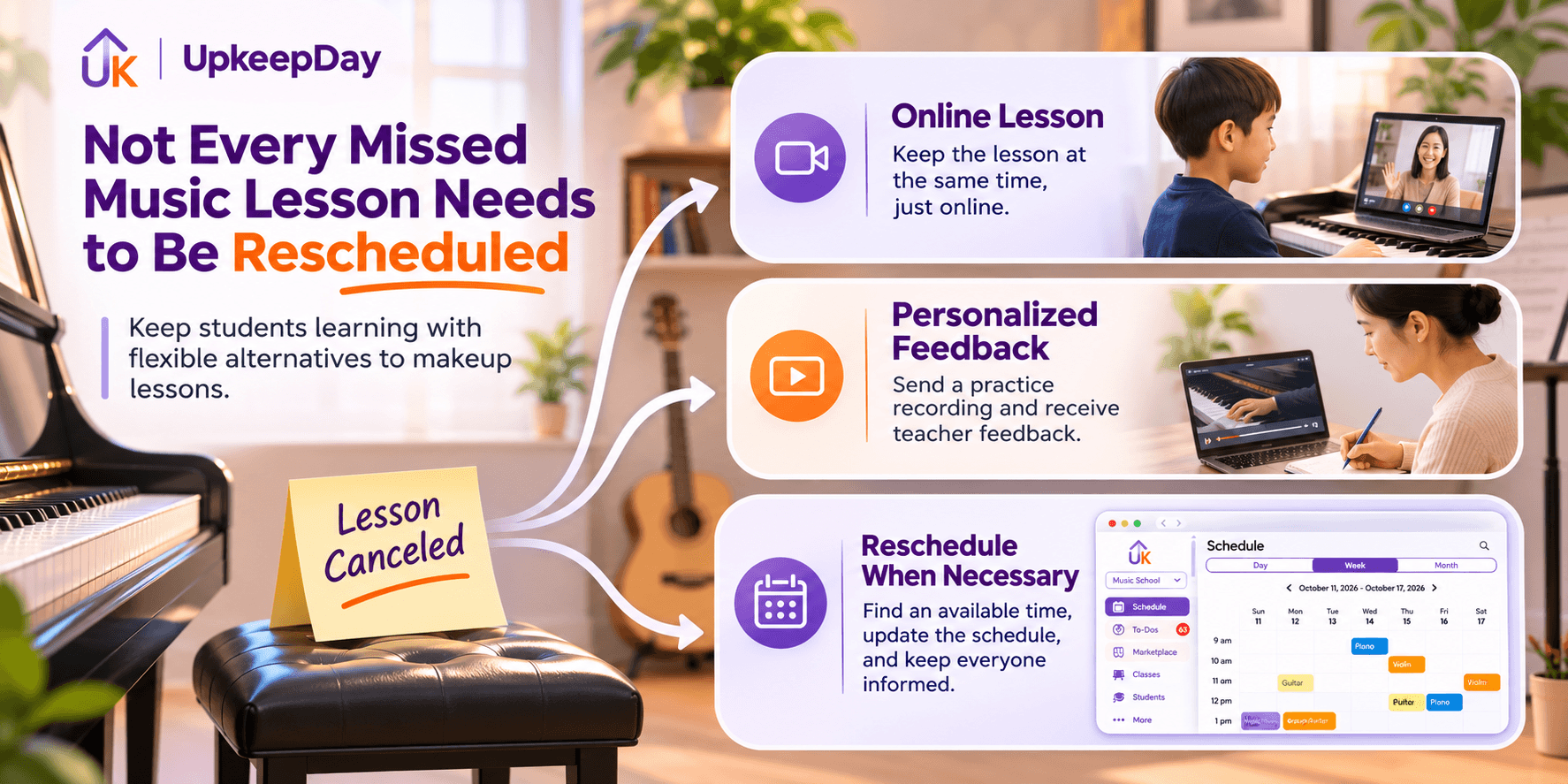
When a student couldn’t attend, the school could offer alternatives such as:
- Attending the regular lesson online.
- Submitting a recording of their playing for teacher feedback.
- Receiving a personalized practice video prepared during the student’s reserved lesson time.
The idea was simple.
Rather than automatically moving a lesson to another day, find ways to use the time already reserved for that student.
The operator presented these as changes they intended to try, not as proven results. But the underlying approach is worth exploring.
The Real Scheduling Problem: You Can’t Replace Every Empty Hour
Consider a music school with eight teachers.
Most students attend after school, between 3 PM and 7 PM.
These are also the hours when teachers are busiest and when new families want to enroll.
Now imagine a student cancels their regular Tuesday appointment.
That opening may be too short-notice to fill with another student.
The family requests a makeup lesson on Thursday, but Thursday is already fully booked.
The administrator might try Friday evening or Saturday morning.
But those alternatives may require the teacher to work outside their usual schedule or give up time that could otherwise be used for another student.
The difficulty isn’t necessarily a lack of available hours across the entire week.
It’s a mismatch between when families are available and when qualified teachers have appropriate openings.
For example, a violin teacher may have availability at 11 AM on Tuesday. That doesn’t help a student who attends school until 3 PM.
And an available piano instructor cannot necessarily substitute for an advanced cello lesson.
In a music school, an empty calendar slot isn’t automatically a usable lesson slot.
It must match the student’s needs, the teacher’s qualifications, the family’s availability, and sometimes the room or instrument requirements.
This is why simply offering unlimited rescheduling often becomes difficult as a school grows.
What If the Lesson Could Continue Without Rescheduling?
Instead of treating every cancellation as an appointment that needs to be moved, consider what the student actually needs that week.
A regular music lesson provides several things: instruction, feedback, guidance, accountability, and motivation.
Some of those benefits may still be possible even when the student cannot attend in person.
Here are several approaches worth considering.
Option 1: Keep the Original Time, but Teach Online
A student cannot travel to the studio because of a transportation problem, bad weather, or another scheduling complication.
However, they are available at their normal lesson time.
Could the lesson happen online instead?
For some instruments and skill levels, this can be an effective alternative.
A piano teacher can demonstrate fingering, explain a musical passage, review technique, and assign practice material.
A vocal instructor may be able to provide useful coaching remotely, although audio limitations should be considered.
Online instruction isn’t appropriate for every student or every lesson, but it may prevent unnecessary cancellations.
The important difference: The lesson stays at its original time. Only the delivery method changes.
Option 2: Use the Reserved Time for Personalized Feedback
Suppose a student cannot attend their regular guitar lesson, but they have been practicing a difficult piece.
The teacher could ask the family to submit a short recording in advance.
During the student’s reserved appointment, the teacher reviews the recording and provides feedback.
For example:
“Your rhythm is much more consistent in the opening section. This week, work on the transition between measures 12 and 13. Practice slowly with a metronome before increasing the tempo.”
The student receives specific guidance and a clear practice objective.
The teacher can complete the work during the time already allocated to that student.
This approach can be useful when a student needs guidance but cannot participate in a live lesson.
However, recorded feedback isn’t automatically equivalent to a full private lesson. Schools should agree with families on when this format is appropriate and how it fits their enrollment terms.
Option 3: Provide a Structured Practice Session
A beginning piano student may be struggling with a particular exercise.
Rather than leaving the student without direction until the following week, the teacher could prepare a short guided practice activity.
It might include a demonstration of the difficult passage, a rhythm exercise, and an achievable goal for the next lesson.
The objective isn’t to send a generic video.
It’s to provide something relevant to the student’s current learning needs.
For more advanced students, this could involve an interpretation exercise, sight-reading assignment, or targeted recital preparation.
Again, the school should be clear about whether this replaces an eligible lesson or supplements the student’s learning.
Option 4: Reschedule When Rescheduling Is Actually Necessary
Sometimes a replacement appointment really is the best solution.
A beginner may need hands-on help with instrument positioning.
A student preparing for an important audition may need direct interaction with their regular instructor.
Or a teacher may have canceled the original lesson, meaning the school still needs to provide the promised instruction or an appropriate alternative.
In these cases, rescheduling makes sense.
The improvement is treating a new appointment as one possible solution, rather than the automatic answer to every absence.
What Happens When the Makeup Lesson Is Missed Too?
This is where clear communication becomes especially important.
Suppose a family cancels a regular piano lesson and receives an eligible makeup appointment for the following week.
That second appointment is confirmed.
But the student doesn’t attend.
Does the school create a third appointment?
There is no universal answer. It depends on the enrollment agreement, the reason for the absence, and any applicable obligations.
What matters is that the school has a defined process rather than negotiating the answer from scratch each time.
For example, a school could decide that a family-requested makeup appointment, once confirmed, uses the family’s available makeup opportunity if missed without sufficient notice.
That expectation should be explained before the replacement appointment is booked, with reasonable provisions for illness or exceptional circumstances.
School-initiated cancellations should be treated separately. Families should not lose promised instruction simply because a teacher or school couldn’t provide the original appointment.
The objective is consistency and fairness—not creating rules that discourage sick students from staying home.
A Better Question for Administrators to Ask
When a parent requests a schedule change, the natural question is:
“When can we fit this lesson in?”
But there may be a better question:
“What’s the best way to support this student’s learning without creating unnecessary disruption?”
Those questions can lead to different outcomes.
Consider three examples.
A student is visiting relatives but has access to their instrument.
An online lesson at the regular time may work.
A student has a school event but can submit a recording beforehand.
Personalized teacher feedback may be an appropriate alternative if the family agrees.
A student cannot participate at all because of illness.
The school follows its cancellation policy, taking into account the student’s circumstances and any applicable makeup or credit entitlement.
These scenarios don’t require exactly the same response.
And they shouldn’t automatically generate exactly the same scheduling task.
Keep the Calendar Connected to What Actually Happened
Once schools offer different ways of handling missed lessons, recordkeeping becomes particularly important.
A canceled lesson, an online lesson, a completed makeup session, and a feedback-only activity are not necessarily equivalent.
Administrators need to understand what was scheduled, what was delivered, and whether any further action is required.
Otherwise, a family might believe a makeup lesson is still outstanding while the teacher believes they have already fulfilled the obligation.
A practical system should distinguish the original appointment from any confirmed replacement and retain the history of changes.
For multi-teacher schools, it also helps when everyone can reference the same schedule.
For example, UpkeepDay’s music school management software provides centralized scheduling for recurring lessons, cancellations, rescheduling, teacher assignments, and lesson feedback.
The purpose of a connected system isn’t to force every problem into a scheduling workflow.
It’s to help teachers and administrators coordinate the work that actually needs to happen.
Try a Four-Week Experiment Before Changing Your Entire School
If your team spends too much time rearranging lessons, start with one small experiment.
Choose two or three instructors who are comfortable offering alternative lesson formats.
For four weeks, give eligible families a choice between appropriate options, such as keeping the original appointment online, receiving agreed-upon personalized feedback, or requesting an available replacement appointment.
Record what happens.
How many families still request new time slots?
How much administrative coordination is required?
Do teachers find the alternative formats manageable?
Do parents understand what they’re receiving?
Most importantly, are students continuing to make progress?
You may discover that online appointments work well for older piano students but not for young beginners.
Perhaps vocal students appreciate recorded feedback, while violin students strongly prefer live instruction.
Your school doesn’t need one rigid answer for every lesson.
It needs a process that matches its programs and families.
Once you understand which alternatives work, you can consider how to incorporate them into future enrollment terms and teacher workflows.
The Goal Isn’t Fewer Lessons. It’s Better Continuity.
Music schools succeed when students continue learning, teachers can do their best work, and families trust the experience.
A missed appointment doesn’t always have to mean a missed learning opportunity.
And helping a student continue learning doesn’t always require moving an appointment to another day.
Sometimes the best solution is an online lesson.
Sometimes it’s personalized feedback.
Sometimes it really is a makeup appointment.
The goal isn’t to reschedule every canceled lesson. It’s to make sure a scheduling change doesn’t automatically become a disruption to learning.
That shift in thinking can help music schools protect teachers’ time, reduce unnecessary administrative work, and create a more dependable experience for families.