
Practical ways to reduce scheduling conflicts, manage cancellations, and create a more reliable experience for students, parents, and teachers.
By the UpkeepDay Team
Tutoring Center Scheduling Problems: How They Affect Student and Teacher Retention
It’s Thursday morning. One of your teachers calls in sick.
They have three lessons scheduled today: essay writing at 10 AM, PSAT preparation at 11 AM, and second-grade homework support at noon.
Now someone has to find a replacement, check availability, make sure the substitute is qualified to teach each subject, update the schedule, and notify the affected students.
Meanwhile, a parent requests a makeup lesson, another student cancels tomorrow’s appointment, and an instructor asks whether their Friday schedule has changed.
What started as a manageable teaching day turns into an hour of messages, phone calls, and calendar adjustments.
For tutoring centers with multiple instructors, these situations are familiar.
A scheduling conflict might seem like a minor administrative inconvenience. But when scheduling problems become frequent, their impact extends beyond the calendar.
They can gradually undermine parent confidence, interrupt student progress, frustrate teachers, and make running the tutoring center more difficult than it needs to be.
The good news? Many of these problems can be prevented with a more structured approach to scheduling.
1. How Scheduling Problems Affect Student Retention
Parents enroll their children in tutoring because they expect consistent academic support, reliable teachers, and measurable improvement.
A predictable schedule is an important part of that experience.
Students lose learning momentum
Consider a student receiving mathematics tutoring twice a week.
The teacher structures lessons so that each session builds on the previous one. But frequent cancellations, scheduling conflicts, and delayed makeup lessons interrupt that progression.
The student may forget previously covered material or require additional review before moving forward.
For students preparing for standardized tests or working through academic difficulties, consistent attendance is especially important.
Parents begin questioning reliability
Most parents understand that occasional scheduling changes are unavoidable.
Problems arise when parents repeatedly need to:
- Confirm whether a lesson is still happening.
- Follow up about canceled sessions.
- Ask when a makeup lesson will be scheduled.
- Check which instructor will be teaching their child.
A parent may begin thinking:
“I’m already juggling school, work, and activities. Why do I have to keep managing my child’s tutoring schedule too?”
Even when teaching quality remains excellent, an unreliable administrative experience can reduce confidence in the organization.
Families gradually disengage
Student retention doesn’t always decline because someone is unhappy with a teacher.
Sometimes the tutoring arrangement simply becomes inconvenient.
A family starts missing lessons, postponing makeup sessions, or struggling to find a consistent time.
Eventually, renewing their tutoring package becomes less of a priority.
Scheduling problems are rarely the only reason families leave, but they can become a preventable source of dissatisfaction.
The objective isn’t simply to keep the calendar full. It’s to make attending tutoring consistently easy for students and their families.
2. How Scheduling Problems Affect Teacher Retention
Teachers experience scheduling problems differently from parents.
For instructors, scheduling affects working hours, earnings, preparation time, and overall job satisfaction.
Unpredictable schedules create frustration
Imagine a teacher scheduled to work from 3 PM to 7 PM.
Two students cancel, leaving only two lessons separated by a long gap.
The instructor may spend several hours at the center while being paid for only part of that time, depending on the center’s compensation policies.
Occasional cancellations are understandable. But when unpredictable schedules become routine, instructors may look for more stable teaching opportunities.
Last-minute changes reduce teaching quality
Teachers need time to prepare lessons, review student progress, and organize learning materials.
When an instructor receives an unexpected student assignment or substitute request, preparation becomes more difficult.
A qualified substitute may be perfectly capable of teaching the subject, but they still need appropriate information about the student’s learning level and previous lessons.
Good substitute management involves more than finding an available teacher.
Administrative confusion damages trust
Teachers shouldn’t need to constantly ask:
“Was my lesson canceled?”
“Am I teaching this student today?”
“Who is covering my afternoon classes?”
“Will I be paid for the canceled session?”
Clear scheduling procedures communicate respect for instructors’ time.
This matters for student retention too. Students often build strong relationships with their regular tutors, and losing an experienced instructor can disrupt that continuity.
A reliable schedule supports teachers as well as students.
3. Five Practical Ways to Improve Tutoring Center Scheduling
Improving scheduling doesn’t necessarily require new software.
Start by establishing consistent procedures that administrators, teachers, and parents can understand and follow.
Step 1: Make recurring schedules the default
Whenever possible, assign each student a regular day, time, and teacher.
For example:
Emma — Mathematics — Tuesdays at 4 PM — Teacher Sarah
Rather than arranging each appointment individually, reserve that time for Emma until someone intentionally changes it.
Recurring schedules provide several advantages.
Students develop consistent learning routines. Parents can plan other activities around tutoring appointments. Teachers have more predictable working hours.
For centers offering flexible tutoring, maintain a separate pool of available lesson times instead of regularly reorganizing established schedules.
Practical tip: Before each semester or enrollment period, ask families to confirm their preferred recurring lesson times. This helps identify scheduling problems before classes begin.
Step 2: Establish a clear cancellation and makeup lesson policy
Every center needs a policy that answers a few essential questions.
How much advance notice must parents provide? What happens when a student cancels at the last minute? How long does a family have to schedule a makeup lesson? Can another qualified teacher provide the makeup session?
For example, a center might require 24 hours’ notice for cancellations and allow eligible makeup lessons within a defined period, subject to availability.
The exact rules should reflect the center’s programs, agreements, and applicable requirements.
More importantly, policies should be communicated during enrollment rather than explained only after a scheduling disagreement occurs.
Practical tip: Track canceled lessons separately from completed makeup lessons. Otherwise, outstanding sessions can easily disappear into a calendar without being resolved.
Step 3: Create a substitute-teacher process before you need it
One of the most disruptive situations for a tutoring center is an unexpected instructor absence.
Without a predefined process, administrators begin contacting teachers individually, checking availability, and deciding who can cover which subjects.
Instead, maintain a substitute-teacher plan that includes:
- Instructors’ subject qualifications and grade levels.
- Their available teaching hours.
- Any restrictions on substituting for particular classes.
- Whether parent approval is required.
- How lesson information will be shared with the substitute.
Consider the Thursday scenario from our introduction.
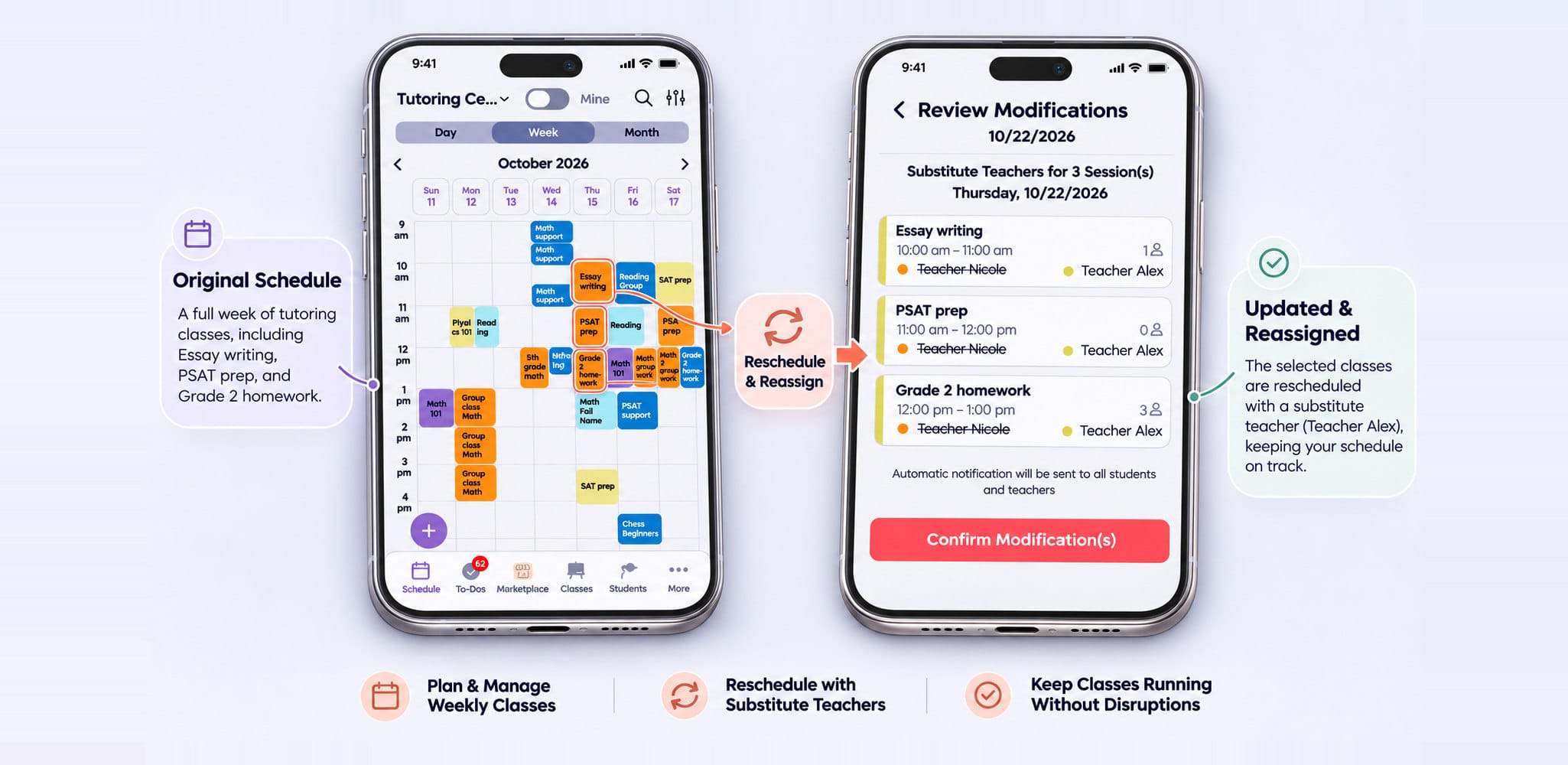
Teacher Nicole cannot attend her three lessons. Teacher Alex is available and qualified to cover them.
Rather than canceling all three appointments, the administrator can reassign them to Alex, confirm the changes, and notify the affected students and teachers.
The students keep their scheduled learning time, Nicole’s absence is managed, and Alex knows exactly which lessons to teach.
This is an example of how structured teacher reassignment can preserve instructional continuity without forcing families to rearrange their day.
Practical tip: Review substitute coverage at the beginning of each term, especially for specialized subjects such as advanced mathematics, SAT preparation, and foreign languages.
Step 4: Maintain one reliable schedule
Many scheduling mistakes happen because information exists in multiple places.
A parent requests a change through a text message. An administrator updates a spreadsheet. A teacher continues using an older calendar.
Everyone believes their information is correct, but the schedules no longer match.
A tutoring center should maintain one authoritative schedule that teachers and administrators can reliably reference.
Every schedule change should follow the same process:
Request received → Availability checked → Change confirmed → Schedule updated → Affected people notified
One important rule: a requested change isn’t a confirmed change.
If a parent asks to move Wednesday’s lesson to Thursday, don’t remove the original appointment until the replacement is actually confirmed.
This simple distinction can prevent double-bookings, missed lessons, and unnecessary confusion.
Practical tip: Make sure staff know who has permission to modify schedules. Not everyone who receives a request should independently change an appointment.
Step 5: Review scheduling problems before they become complaints
Dedicate 15–20 minutes each week to reviewing the upcoming schedule and recent changes.
Look for unresolved makeup lessons, instructor conflicts, classes without assigned teachers, repeated cancellations, and students with irregular attendance.
Pay attention to patterns rather than isolated events.
If the same family repeatedly cancels Wednesday appointments, their recurring time may no longer work.
If a teacher has several long gaps between lessons, reorganizing their teaching block might improve their experience.
If students regularly miss a particular group class, its timing may be inconvenient.
A recurring scheduling issue is often a signal that the current arrangement needs adjustment.
Practical tip: Conduct a short weekly scheduling review before the busiest teaching days rather than waiting for problems to appear.
4. A Real-World Example: Reassigning Multiple Lessons Without Disruption
Let’s return to our tutoring center with six teachers and approximately 70 students.
On Thursday morning, a teacher reports that they will be unavailable.
They have three consecutive lessons scheduled.
Without a centralized process, the administrator might need to open multiple calendars, message several instructors, contact families, and manually update each appointment.
With a structured scheduling workflow, the process becomes much simpler.
First, the administrator identifies all lessons affected by the absence.
Next, they check which qualified instructors are available.
They select a substitute and review the affected sessions together.
Finally, they confirm the changes and notify everyone involved.
For example, UpkeepDay allows tutoring centers to view weekly lessons, manage scheduling changes, and reassign multiple sessions to a substitute teacher. The administrator can review the replacement assignments before confirming them, with notifications sent to affected students and teachers.
The important benefit isn’t simply completing the changes faster.
It’s maintaining continuity without leaving families or instructors uncertain about what happens next.
A centralized schedule should help the center answer three questions at any moment:
What’s happening? Who is teaching? Who needs to be informed?
When those answers are readily available, routine changes become much easier to manage.
5. How to Measure Scheduling Improvements
You don’t need a complicated analytics dashboard to understand whether your scheduling process is improving.
Start with four indicators.
| Indicator | What it reveals |
|---|---|
| Unresolved makeup lessons | Whether canceled sessions are being properly addressed |
| Average time to confirm schedule changes | How efficiently the center responds to families |
| Last-minute teacher schedule changes | How predictable instructors’ working conditions are |
| Students with repeated cancellations | Which families may need more suitable recurring times |
Review these indicators monthly.
Compare trends with student package renewals, parent complaints, and instructor feedback.
For example, if a family has missed three lessons in a month, a proactive conversation about changing their recurring appointment may be more useful than repeatedly offering makeup sessions.
Scheduling improvements won’t automatically guarantee better retention. However, they can remove avoidable frustrations that influence how families and teachers experience the center.
6. When Does Scheduling Software Become Necessary?
A tutoring center with one instructor and a small number of students may manage appointments perfectly well using a shared calendar.
As the center grows, however, scheduling becomes more complex.
Multiple instructors, group classes, recurring appointments, individual lesson changes, substitute teachers, and makeup sessions introduce more opportunities for mistakes.
At this stage, dedicated tutoring center scheduling software may help.
Before choosing a system, consider whether it supports the center’s actual workflows.
Can it reschedule one lesson without changing the entire recurring series? Can it detect scheduling conflicts? Can multiple sessions be reassigned to another qualified teacher? Can administrators see all instructors’ schedules? Are affected people informed when confirmed changes occur?
Also consider how easy the system is for teachers and administrators to use.
A complicated platform that requires extensive manual work can create just as much frustration as spreadsheets.
Technology should make an established scheduling process easier to follow, not introduce another administrative burden.
7. Build a Scheduling Process That Supports Retention
Tutoring centers naturally focus on teaching quality, academic outcomes, and attracting new students.
But the experience surrounding every lesson matters too.
For parents, a reliable schedule means fewer surprises and less coordination.
For students, it means consistent learning routines and stronger relationships with instructors.
For teachers, it means predictable working hours and the ability to focus on teaching rather than administrative uncertainty.
For owners and administrators, it means fewer scheduling emergencies and less dependence on constant manual intervention.
The most effective approach doesn’t have to be complicated.
Start with recurring appointments, clear cancellation policies, a substitute-teacher plan, a centralized schedule, and regular reviews of unresolved issues.
A well-managed tutoring schedule does more than organize appointments. It makes it easier for students to keep learning, teachers to keep teaching, and families to stay with your center.